China’s role as a skincare manufacturing hub makes it a natural place to search for an Exfoliating Sugar Body Scrub supplier. But a polished sample is only the beginning. Buyers also need consistent particle size, a pleasant rinse-off feel, stable fragrance, and clear batch documentation. Small differences matter: coarse sugar can feel harsh, while excess oil may leave a slippery film.
The commercial backdrop is substantial, though it needs context. McKinsey’s 2023 beauty-market analysis estimated global beauty sales at about $430 billion in 2022 and projected the market could reach roughly $580 billion by 2027. These figures cover beauty broadly, not body scrubs alone. They signal opportunity, but they do not prove demand for any particular formula. That distinction is worth keeping in view.
A credible supplier should be able to explain ingredient sourcing, production controls, stability testing, and how specifications are checked between batches. Ask for samples, product specifications, and relevant quality records before comparing quotations. Then test the scrub on skin, not just on paper. How does it spread? Does the sugar dissolve too quickly under warm water? Does the scent linger after rinsing? These practical details reveal more than a catalogue image. No supplier is perfect. A thoughtful sourcing process makes weaknesses easier to spot—and helps buyers choose a partner they can verify, not merely one with the lowest price.
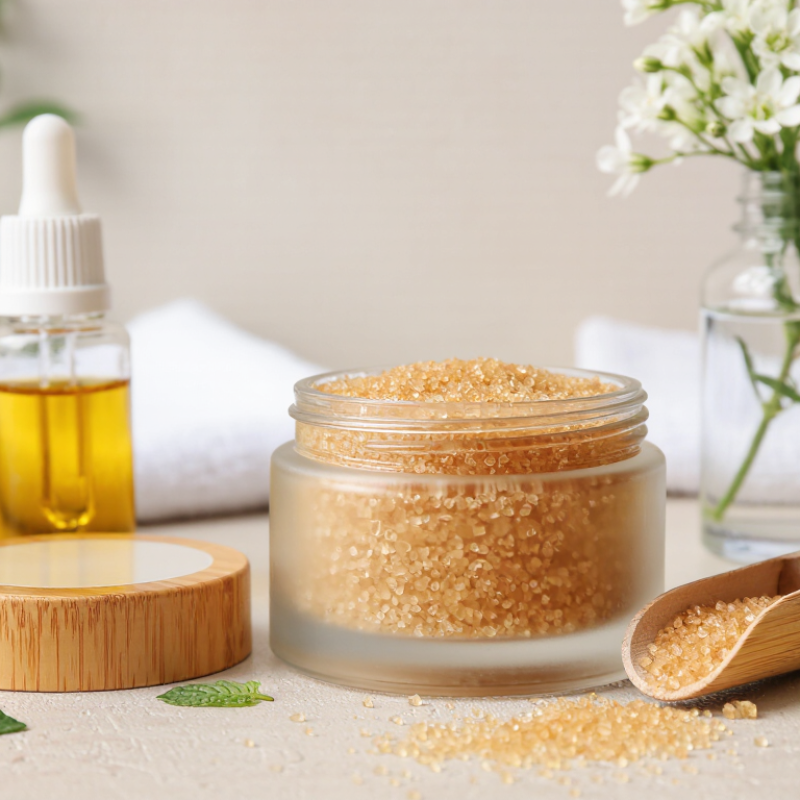
An exfoliating sugar body scrub is a rinse-off product that uses sugar crystals to loosen surface flakes through gentle friction. As the crystals move across damp skin, they gradually dissolve, so pressure and particle size matter. Many formulas also contain oils or moisturizers to reduce that dry, tight feeling after rinsing. It is still a physical exfoliant, not a treatment for every skin concern. That distinction matters.
The Cosmetic Ingredient Review’s 2014 safety assessment concluded that sucrose is safe for cosmetic use under the conditions assessed; that finding concerns the ingredient, not every finished scrub or user. The American Academy of Dermatology also cautions that exfoliation can aggravate dry or sensitive skin. Use a small amount on wet skin, move lightly, and rinse well. Skip broken or irritated areas. Less pressure is usually wiser. In practice, “gentle” is not guaranteed by sugar alone: coarse particles, fragrance, and vigorous rubbing can change how a formula feels. I would not judge a supplier’s scrub by grain size alone; ingredient transparency and consistent batch testing deserve a close look, too.
A well-designed sugar body scrub starts with the crystals. Fine granules provide gentler polishing, while larger crystals feel more pronounced on rough areas like elbows and heels. The right choice depends on the intended use and the rest of the formula. Sugar dissolves during rinsing, but it can still feel abrasive if the particles are too coarse or used with heavy pressure.
The oil phase shapes glide and after-feel. Sunflower or coconut oil can help reduce friction, while glycerin may support a softer skin feel. Too much oil, though, can leave a slippery film in the shower. A balanced formula often includes an emulsifier, helping oils rinse away more evenly.
Small details matter. Check that the scrub stays uniform and that crystals do not settle or clump during storage. Water can enter a jar during use, so packaging and preservation need careful assessment based on the formula. Stability and appropriate microbial testing provide useful evidence; appearance alone is not enough.
There is no perfect texture for everyone. Even a carefully developed scrub may feel too rough on sensitive skin, so usage directions should stay clear and realistic.
Manufacturing a sugar body scrub begins with checks on incoming materials. Staff confirm the sugar grade, particle size, oil quality, and packaging condition before weighing ingredients. Coarse crystals can feel harsh, while very fine sugar may dissolve quickly during use. Small details matter. Oils and emollients are blended before sugar is folded in gently. Mixing too aggressively can crush crystals and change the scrub’s texture.
During production, operators record batch weights, mixing time, and temperature. They inspect the mixture for uneven color, dry pockets, or excess oil on the surface. Samples may be checked for appearance, odor, consistency, and pH when the formula makes that test relevant. A clean-looking jar is not proof of product quality. Microbial testing and preservation checks are important when a formula contains water or may be exposed to moisture during use.
Finished samples can also undergo stability checks under different storage conditions. Technicians watch for separation, changes in scent, altered texture, or packaging leaks over time. Packaging compatibility matters; some oils may affect certain materials. A small trial batch can reveal issues before larger production, though it cannot predict every storage condition. This step is easy to rush. It shouldn’t be. Records linking each test to its batch help teams investigate unexpected changes and improve later production.
China Top Exfoliating Sugar Body Scrub Supplier?
How to Evaluate a Chinese Sugar Scrub Supplier
Choosing a supplier takes more than comparing prices or reviewing polished product photos. Ask for a clear ingredient list, current product specifications, and batch-level quality records. Check whether the sugar粒 size is consistent and whether the scrub spreads smoothly without feeling overly abrasive. Request samples from more than one batch if possible. A single sample can be unusually good.
Review how the supplier controls mixing, filling, and packaging. Ask how they check texture, scent, fill weight, and container seals before shipment. For a scrub containing oils or water-based ingredients, ask what stability and microbial testing applies to that formula. Verify that test reports match the product and batch being discussed. No checklist catches everything, and documents alone cannot prove consistent production. A video call or facility audit can add useful context, but it still has limits.
Tips: Compare samples under the same conditions. Note how easily the scrub rinses away, whether sugar dissolves too quickly, and if the jar leaks after transport simulation. Keep written records of agreed specifications. Small details matter.
Use recognized microbiological criteria when reviewing a supplier’s finished-product test reports.
ISO 17516:2014 sets a limit of 100 CFU/g or mL for Category 1 cosmetics (products for children under three, the eye area, or mucous membranes) and 1,000 CFU/g or mL for Category 2 cosmetics (other products). A body scrub intended for use on intact skin will generally fall into Category 2; confirm classification for its intended use. Ask suppliers for finished-product test reports and verification that specified microorganisms are absent in 1 g or 1 mL.
A China-based sugar body scrub supplier should be able to discuss more than scent and color. Customization also involves sugar grain size, oil level, fragrance strength, and how the scrub feels when rinsed. Ask for a written specification and a production sample. Small details matter. A formula that feels smooth in a warm showroom may stiffen in a cooler warehouse, so test it under realistic storage conditions.
Packaging needs the same careful review. A wide-mouth jar is easy to use, but wet hands can introduce water during shower use. Consider a secure inner seal, a sturdy lid, and a carton that limits movement. Check that the label remains readable after contact with oily fingers. Test the filled pack for leakage and damage during handling. Test it twice. A polished mock-up is not proof of shipping durability.
Before placing an export order, confirm ingredient lists, label language, product claims, and required documents with the importer and relevant local specialists. Requirements can differ by destination and may change. Agree on carton dimensions, batch coding, lead time, and who approves artwork before production begins. Keep samples and signed specifications for comparison. One imperfect part of the process is that small design changes can affect packing schedules; build time for another review rather than assuming every detail will be right the first time.
Fine crystals offer gentler polishing. Larger grains feel stronger on rough areas like elbows and heels. Pressure matters, too.
Oils can help the scrub glide with less friction, while glycerin may support a softer feel. Too much oil can leave a slippery film.
An emulsifier can help oils rinse away more evenly. The ideal feel still varies from person to person.
They record weights, mixing time, and temperature. They also inspect for dry pockets, uneven color, and excess oil.
Teams may check appearance, odor, and consistency. Stability and microbial testing can provide useful evidence; appearance alone is not enough.
Review the seal, lid, and label readability. Wet hands can bring shower water into a wide-mouth jar.
Test filled packs for leaks and handling damage. Test it twice. A polished mock-up proves little about shipping durability.
Confirm the written formula, label language, carton dimensions, batch coding, and approval steps. Destination requirements can differ, so allow time for another review.
An Exfoliating Sugar Body Scrub combines sugar crystals with oils and other skin-conditioning ingredients to help lift away surface buildup while leaving skin feeling smooth. Its performance depends on the balance between exfoliating particles and the product’s texture, as well as ingredient quality, stability, and suitability for the intended market. Manufacturing typically involves controlled ingredient handling, consistent mixing, and checks for appearance, texture, scent, packaging compatibility, and product stability.
When evaluating a Chinese sugar scrub supplier, buyers can review manufacturing capabilities, quality-control procedures, communication, production capacity, and experience with export orders. Clear specifications and sample assessments help confirm that the formula meets expectations before larger production runs. Customization may include ingredient preferences, fragrance, scrub texture, container type, labeling, and packaging format. Export planning should also account for lead times, shipping requirements, and destination-market documentation. A careful, step-by-step evaluation can help buyers choose a supplier suited to their product goals and supply needs.